High-Field Field-Cycler (HFFC)
Our High-Field Field-Cycler (HFFC) is a rapid sample shuttler designed for High Field Relaxometry, perfectly adapted for your high-field NMR spectrometer.

Our High-Field Field-Cycler (HFFC) is a rapid sample shuttler designed for High Field Relaxometry, perfectly adapted for your high-field NMR spectrometer.
The compact sample transportation devices, “High-Field Field-Cyclers”, were installed in many worldwide commercial spectrometers. Our device provides high-precision positioning and stability during high-speed sample shuttling and is compatible with commercial high-field standard bore NMR spectrometers with commercial probe heads, including a cryogenically cooled NMR probes.
Various aspects of relaxation studies, such as relaxivity measurements allow to obtain detailed information on protein dynamics and contrast agents for magnetic resonance imaging at the atomic resolution. Despite relaxation studies, our newly developed add-on module (see also Field-Cycling Illuminator) combined with our High-Field Field-Cycler can perform field-dependent photo-related experiments in solutions, for instance photochemical induced nuclear polarization (photo-CIDNP).
The sample is shuttling up and down with acceleration 131.25m/s2. The shown video is the area of the rail approximate to the probe head.
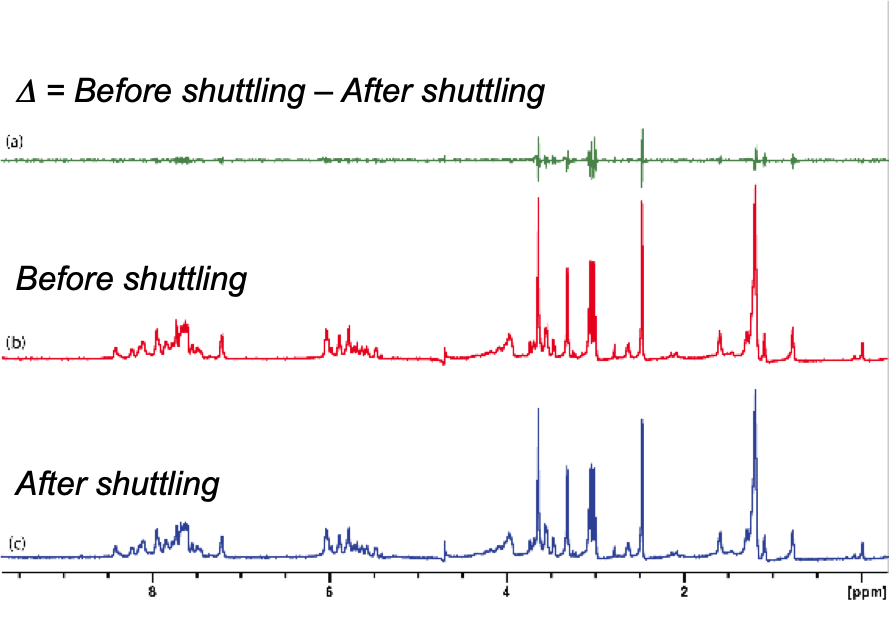
Shuttling on Bruker 700MHz NMR spectrometer equipped with 5mm TCI Bruker cryoprobe for 11,000 shuttling times in 20hours. Sample is 0.2mM UUCG tetra-loop 14nt RNA. Compared spectra are 1H, 10K TD with 8 NS
At NYSBC, the HFFC is installed on the 700 MHz spectrometer with a 5 mm TCI cryoprobe (see NYSBC's instrumentation page). An independent study from this installation demonstrated reliable high-field relaxometry using the system (J. Magn. Reson., 2025).
Their results confirm stable shuttling up to 700 MHz and consistent signal decays across the field range tested. This third-party validation reflects the precision of the shuttle mechanics.
Separately, our own 11,000-cycle stability test (Shown in the above figure) shows spectral quality maintained without post-processing.
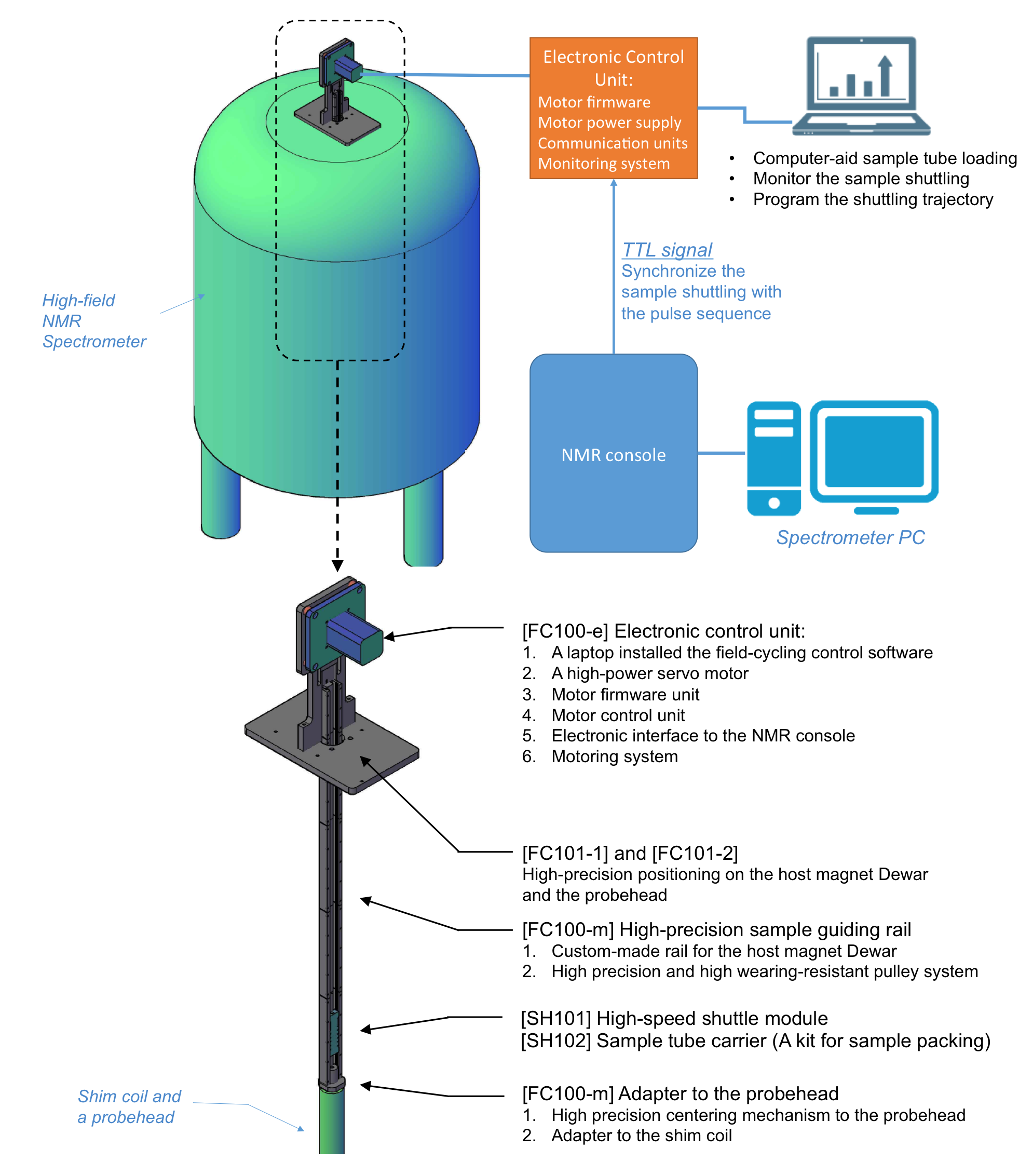
Schematic diagram of the High-Field Field-Cycling (HFFC) system, showing the seamless integration of the sample shuttling unit with commercial NMR spectrometers.
Instantly Download Full Technical Specs
Yes. The HFFC is designed as an add-on to existing high-field NMR spectrometers from major manufacturers including Bruker, Varian, JEOL, and Oxford. It installs within the standard 54 mm bore and requires no permanent hardware modification to the spectrometer or probehead. Installation typically involves a one-time adjustment to the shim stack upper section to accommodate the shuttle rail. For spectrometers with a 52 mm bore (such as older Oxford magnets), installation is also possible with a customized shuttle rail — please contact us to discuss your specific configuration. No separate magnet or console is required. Compatible with spectrometers from 300 MHz to 1.3 GHz (7 T to 30.5 T).
No. The HFFC is designed for permanent installation and does not need to be removed between experiments. For non-shuttling users, the only difference is the sample insertion mechanism — instead of the standard pneumatic lift, samples are loaded via the motor-driven shuttle. Standard 5 mm NMR tubes and Shigemi tubes are fully compatible, so routine NMR experiments on the shared spectrometer can continue without any modification to the user's workflow.
Standalone FFC relaxometers operate at low fields (typically below 1 T) and cannot provide atomic-resolution spectra. The HFFC shuttles the sample within the stray field of your existing high-field magnet, enabling relaxation measurements from near-zero field up to the full spectrometer field — while detection still occurs at high field. This means you retain full chemical-shift resolution and can resolve individual residues in proteins or nucleic acids.
The HFFC operates on a constant acceleration motion profile — at maximum setting, peak acceleration reaches 13G. Both acceleration and maximum speed are adjustable, allowing researchers to reduce G-force for mechanically sensitive samples such as precipitate-prone proteins or fragile biological assemblies. Since stray field profiles vary between magnet models and field strengths, the motion parameters can also be optimized for each specific installation.
Yes. Because detection occurs at high field using your existing probe and console, HFFC delivers site-specific relaxation data across a wide field range. This is the key advantage over conventional FFC relaxometers, which sacrifice resolution for field range.
Yes. The shuttle rail and sample holder are designed to be compatible with commercially available cryogenically cooled probeheads without any special modification. An independent validation study confirmed stable operation on a Bruker 700 MHz equipped with a 5mm TCI cryoprobe over 11,000 shuttling cycles.
Yes, with the optional Field-Cycling Illuminator add-on module. This allows field-dependent photo-CIDNP, LC-photo-CIDNP, and in-situ irradiation experiments across the stray field range of your spectrometer.
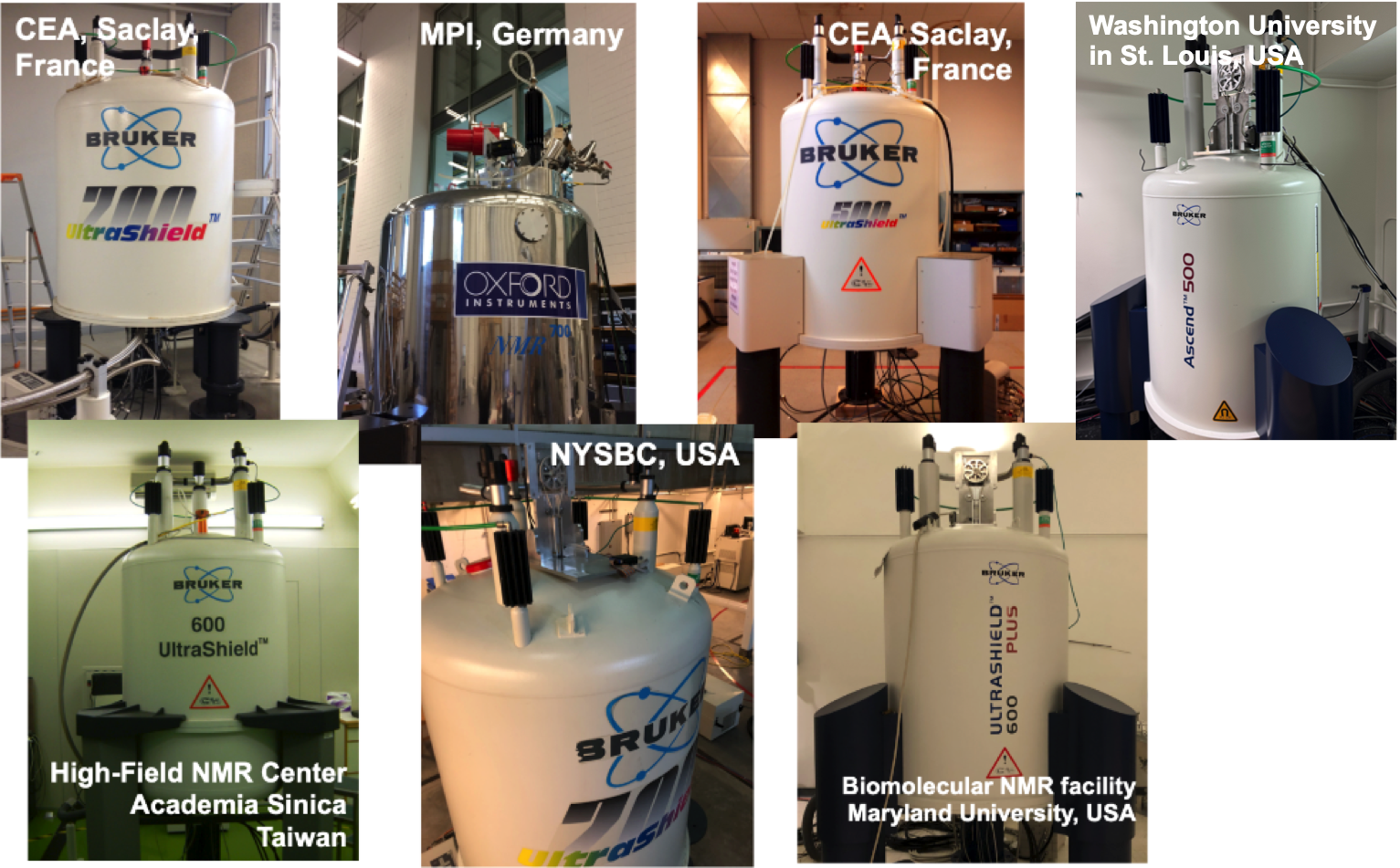
HFFC installations include: New York Structural Biology Center (NYSBC, USA), CEA Saclay (France), Max-Planck Institute (Germany), High-Field NMR Center at Academia Sinica (Taiwan), Biomolecular NMR Facility at University of Maryland (USA), and Washington University in St. Louis (USA).
If you have any question no matter on technical part or pricing, you can submit your message here. We will approach you as soon as possible.
Please make sure the mandatory terms are filled.